The Enduring Appeal of Blackened Steel
Blackened steel is often described in aesthetic terms as dark, moody, industrial, but its true value lies in the interaction between metallurgy, chemistry and fabrication control. At its core, the finish is the result of a surface conversion process, not an applied layer, this distinction underpins everything from its appearance to its performance.
The Role of Mill Scale, Foundation of the Finish
The defining characteristic of blackened steel comes from the preservation of mill scale, the naturally occurring iron oxide layer formed during hot rolling, composed primarily of magnetite, this layer is already dark and irregular, providing a reactive base for further chemical development.
Rather than removing it, as is standard in most fabrication workflows, blackening processes stabilise and manipulate this oxide layer, the patina solution subtly etches, activates and deepens the surface to create tonal variations that cannot be replicated on cold rolled steel where the mill scale has been stripped away.
- Hot rolled steel = visual complexity (layered blacks, blues, greys)
- Cold rolled steel = flat, uniform reaction (often lifeless by comparison)
The Chemistry of Blackening, Controlled Oxidation
The blackening process typically uses mild acidic or oxidative solutions applied at room temperature, rather than aggressively corroding the surface, the chemistry works in a controlled manner to:- Accelerate oxidation in a uniform but non-homogeneous way
- Convert red oxides into darker, more stable compounds
- Create micro-etching that enhances light absorption and reduces reflectivity

This introduces a paradox in which the process is tightly controlled, yet the outcome is intentionally variable. For designers, this means embracing range rather than exact match, a mindset closer to natural stone or timber than to traditional metal finishes.
Surface Topography & Light Interaction
At a microscopic level, blackened steel is not smooth, the combination of mill scale retention and chemical etching creates a micro-textured surface that interacts with light in complex ways:- Diffuse reflection softens glare, giving a matte or eggshell appearance
- Specular highlights emerge on denser areas of mill scale
- Variations in absorption create a sense of depth, almost like a living surface

Under directional lighting, this becomes especially powerful, raking light reveals subtle patterning, while even ambient lighting produces a low-gloss, velvety finish that reads as both heavy and refined.
Fabrication Impacts, Welding, Forming & Handling


Because blackening is a post-fabrication process, every upstream decision leaves a trace:
- Welds, areas where mill scale has been burned off react differently, often appearing flatter and more charcoal-toned, our skilled fabricators can blend or celebrate this contrast.
- Folding & rolling, mechanical deformation can fracture mill scale, introducing linear highlights or stress marks that become part of the final aesthetics.
- Handling marks, oils, fingerprints and water exposure pre-treatment can subtly influence the patina, adding another layer of uniqueness.


Rather than defects, these are embedded narratives of manufacture and visible evidence of how the material was shaped.
Sealing Systems, Performance vs Aesthetics
Once the desired patina is achieved, sealing becomes critical, not just for protection but for locking in a specific visual state. Different systems produce markedly different outcomes:
1k Solvent Lacquer 30% Gloss

Wax

Polyurethane Powder Coat
The choice here is not purely technical, it’s architectural. It determines whether the surface reads as raw, refined or highly engineered.
Environmental & Material Considerations
Compared to heavily processed finishes, blackened steel is relatively low-intervention:- No high-temperature curing required for the patina itself
- Minimal chemical volumes compared to plating or galvanising
- Compatibility with renewable-powered fabrication environments

However, it remains a mild steel substrate, meaning:
- It is inherently susceptible to corrosion if coatings fail
- Best suited for controlled interior environments
- Requires careful detailing around edges, joints, and fixings
Architectural Positioning, Where It Excels
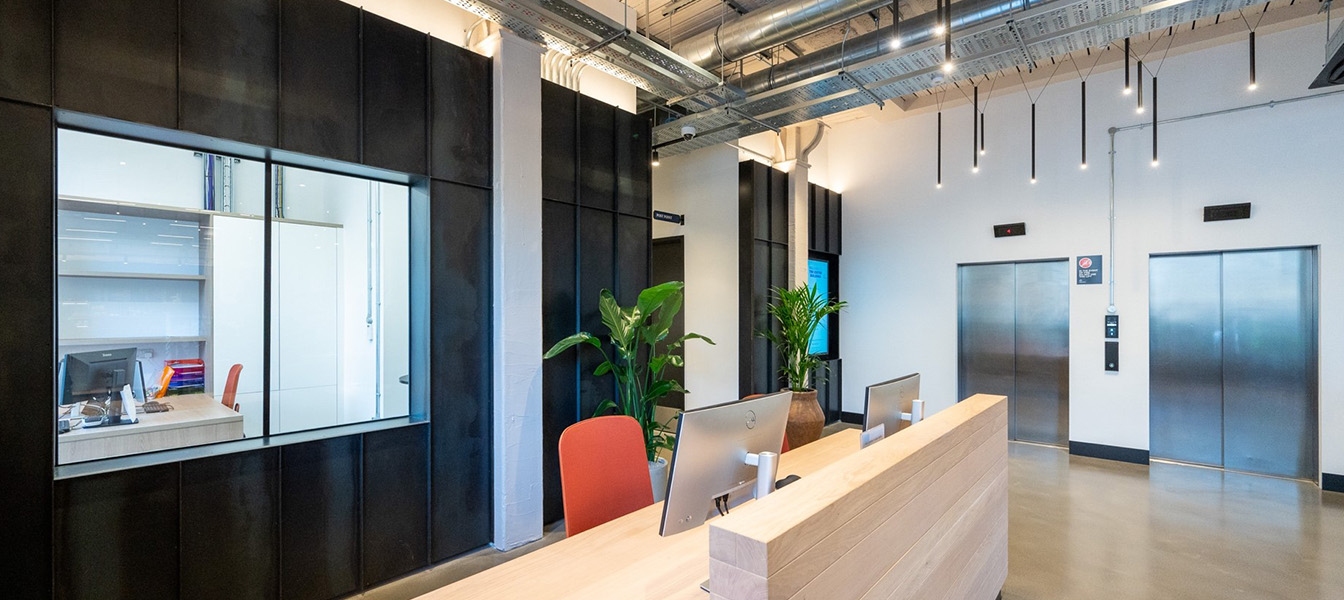
Blackened steel is most effective when used with intent:- Feature walls and vertical cladding
- Reception desks and branded environments (low abrasion zones)
- Lift lobbies, partitions and integrated signage
- Backdrops where light and shadow can activate the surface
- Horizontal, high-contact surfaces
- External applications without significant modification
- Environments with constant moisture exposure

Blackened steel sits at the intersection of predictability and variation, it is engineered enough to meet architectural standards, yet expressive enough to retain the spontaneity of a hand-finished material.

Its real strength is not just how it looks, but how it records process, the heat of rolling, the chemistry of oxidation, the pressure of forming and the decisions of the fabricator.

Making every panel not just a finish but a material document of its own making.


